








Pre-Shipment Records for Modular Buildings
Which documents and inspection records to agree before production, and to receive before a modular building shipment leaves the factory.
Short answer: Agree the records when the order is placed, and receive them before the container is sealed. Before a modular building shipment leaves the factory, an importer should hold:
- the approved drawings and the specification revision the order was produced to;
- the factory inspection records for the checks named in the agreed inspection plan;
- a packing list with package dimensions, weights and lifting points, and shipping marks that match it;
- loading records: photographs of the cargo, packaging, securing and each loading stage, with the container and seal numbers;
- the commercial invoice, the bill-of-lading details and any certificate of origin the destination requires;
- every certificate or test report you rely on, checked for model, issuing body, date and scope.
Records that were not agreed before production are difficult to obtain after loading.
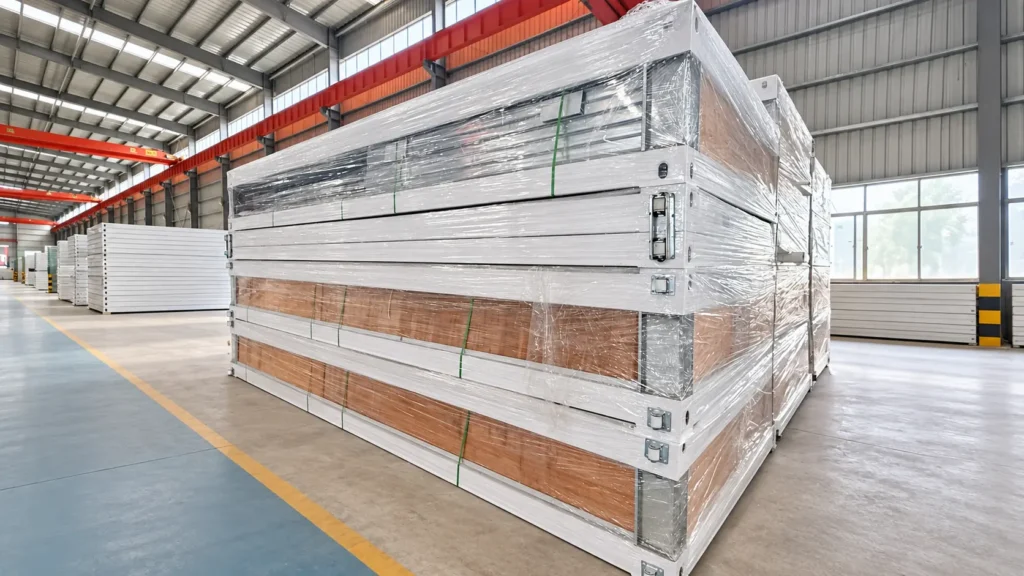
Agree the records before production starts
An inspection plan belongs in the order, not in the last week before loading. Before production is released, agree the inspection points, the acceptance criteria and the records that will show each check was made. The same agreement should cover the drawing approval path, finish samples, change control and the final production release, so that everyone knows which revision the factory is building.
Keep three responsibilities apart: factory inspection, site installation checks and final acceptance. A factory record shows what was checked before dispatch. It does not replace the checks that follow installation, or the acceptance of the finished building on site.
Keep a document register that lists each record, its revision and who approves it, and ask for every document to use the same configuration reference. The flat-pack procurement guide treats several model names for one offered configuration as a warning sign. The same lines belong in the quotation itself: comparing flat-pack site office quotations shows how to set out programme, acceptance and document lines before ordering.
Premium Modular House (PMH) offers production photographs and videos so that buyers can follow an order through production, and documents its quality control and loading checks. Agree in advance which stages you want to see.
Factory inspection records
Each check should relate to the offered configuration and the approved inspection plan, not to a general product description. A useful set of records covers:
| Check | What the record should show | Why it matters |
|---|---|---|
| Materials | Identification of the steel, panels, boards and fittings against the specification revision | Confirms that the offered build-up was used |
| Dimensions | Measured sizes of modules or components against the approved drawing | Fit on site depends on them |
| Coating | The coating checks named in the inspection plan | Coating is hard to verify after delivery |
| Connections | Connection components and the checks agreed for the building system | Assembly relies on matching parts |
| Sealing | Sealing strips and sealant installation | Weather tightness starts in the factory |
| Services | Electrical installation and, where fitted, plumbing checks | Defects are cheaper to correct before dispatch |
As an example of a documented control, PMH's guide to bathroom pods and sanitary modules cites the factory technical documentation: sealing strips and sealant installation quality are routine inspection items, electrical installation is inspected, and insulation resistance is specified at not less than 0.5 MΩ. Ask for the measured result for your modules, not only the specified value.
Distinguish type tests from production records. The same documentation includes floor bending in type testing, with a reference floor live load of 2.0 kN/m². A type test shows how a reference design performed. It is not a record of the modules in your shipment, so ask which type test applies to the offered configuration and what the production records show.
A product photograph is not inspection evidence either. Ask for drawings, material identification, work instructions and the agreed inspection records instead.
Packing list and shipping marks
The packing list is the document your receiving team will work from. Request one that shows package dimensions, weights, lifting points and the number of packages per shipping container or truck. Each package should carry the project name, module number and component list, so that loose parts can be matched to the right module on arrival.
Before loading, confirm:
- quantities against the order;
- the marking on every package;
- how accessories and loose items are packed;
- the document set for each shipment;
- the destination and the handling plan;
- the delivery sequence, if the project ships in phases.
The packing list and shipping marks should be complete, and the packaging undamaged, before the goods go into the container. The guide to shipping modular buildings from China explains what a supplier needs to plan the loading and price the freight.
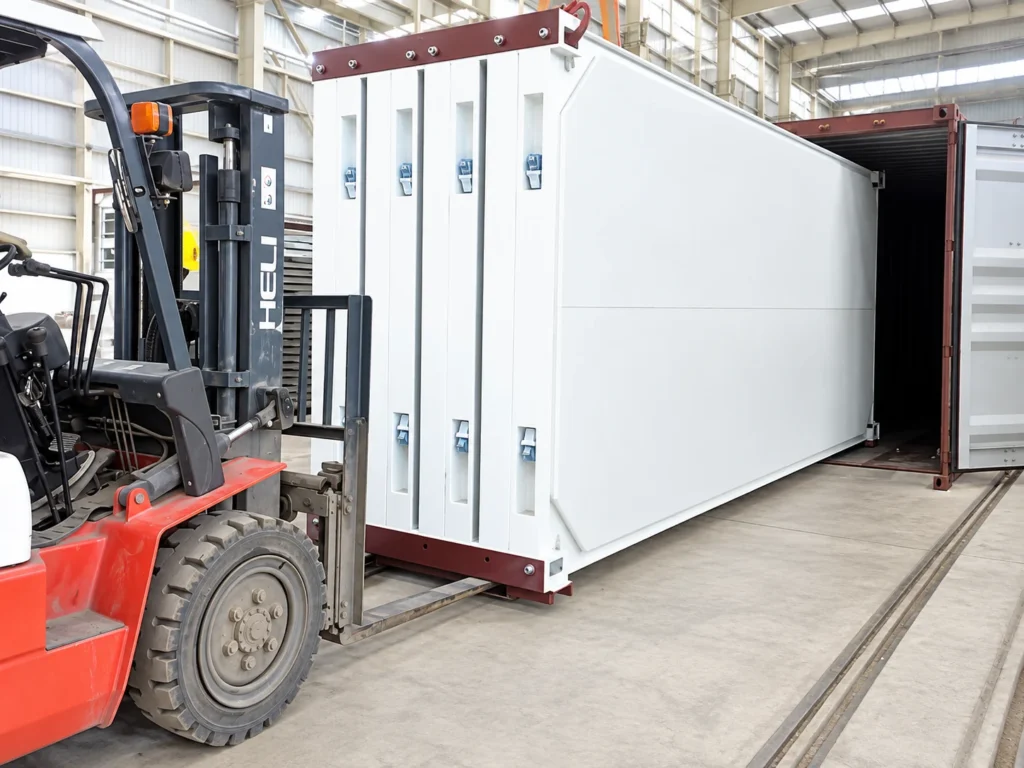
Loading records
Loading records show the condition of the goods when the supplier hands them over. For Flat-Pack Container House shipments, PMH checks the empty freight container, the cargo condition, the packaging and the cargo securing before loading, and keeps photographs from before loading and through each loading stage. The photographs record the cargo, packaging and shipping marks, and the container and seal identification. The completed packing list, loading weight and volume are then compiled for the logistics team.
Ask to receive these records for each container, labelled with the container and seal numbers. Your receiving team can then compare the cargo on arrival with its condition at loading.
Shipping and customs documents
Tell the supplier which documents your importer or customs broker needs before the goods are booked. For each order, PMH confirms the commercial invoice and packing list for the agreed shipment, confirms the bill-of-lading details alongside the ocean freight arrangements, and discusses certificate-of-origin requirements for the destination. Confirm the final list with your customs broker, because the requirements depend on the destination and the shipment.
Certificates and test reports
Check every certificate or test report against four things: the product model, the material, the issuing body and date, and the scope. A report for one sample should not automatically be treated as evidence for every project configuration. A certificate for a named component, such as a board or a membrane, applies only to that component and its test scope, and component marks do not certify the complete building.
Ask which drawings, test evidence and destination documentation apply to the offered configuration, and do not assume that every option is included.
What to check again after delivery
Some checks cannot be closed in the factory. The inspection plan should identify what is tested in the factory, what transport can disturb and what must be checked again after installation. Drains, penetrations and thresholds in wet areas, for example, need water checks once the modules are connected.
For sanitary and laundry facilities, PMH asks the proposal to identify the factory checks, site connections, testing responsibilities and handover records. Handover then closes with the agreed inspection points, a punch-list process, spare parts, training and document closeout. The flat-pack camp site preparation guide covers the site work that has to be ready before delivery.
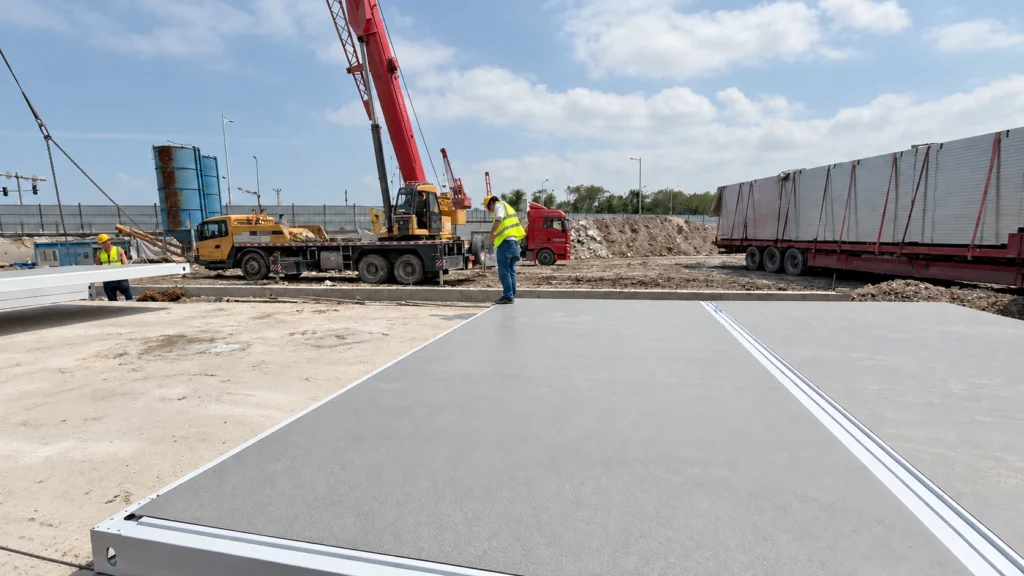
Send your inspection and document requirements to PMH. Include the destination, the configuration, the inspection points you want to receive and the documents your importer needs, so that the records can be agreed with the order.
Questions buyers ask
Is a type test report enough for our order?
No. A type test shows how a reference design performed. Ask for the production inspection records of your modules as well, and check that the type test covers the offered configuration.
Can we follow our order during production?
Agree it in advance. PMH offers production photographs and videos, and documents its loading checks for flat-pack shipments.
Which documents travel with the shipment?
Usually a commercial invoice, a packing list and a bill of lading. A certificate of origin may be needed for the destination. Confirm the list with your customs broker before the goods ship.
What if a shipping mark does not match the packing list?
Treat it as an open item before loading. A mismatch found at the destination is harder to resolve than one corrected before the container is sealed.